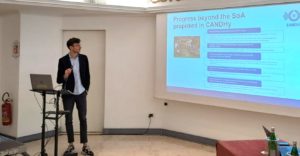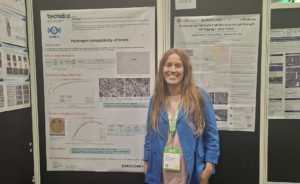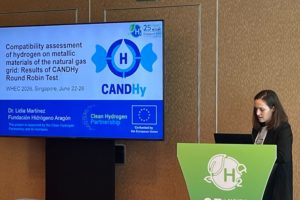
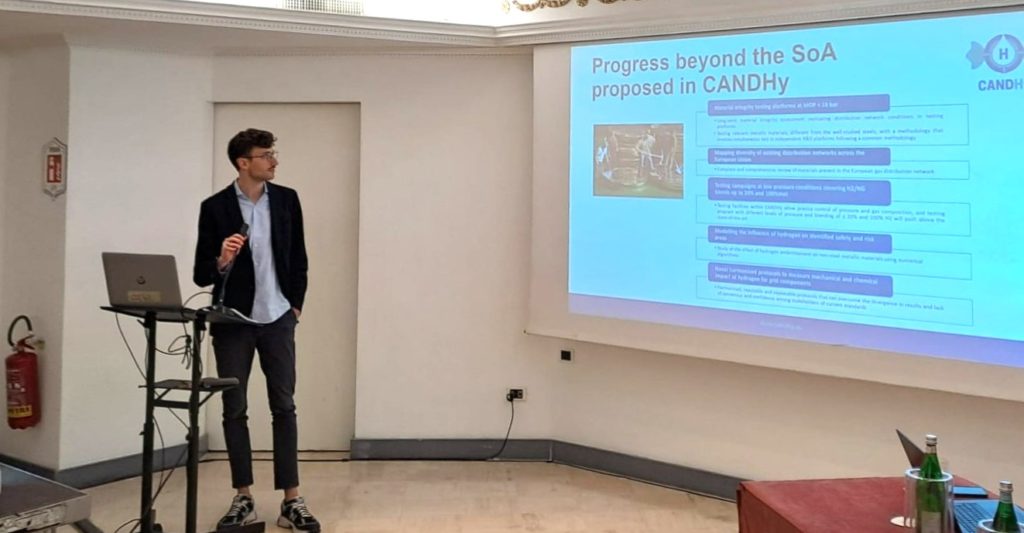
CANDHy presented the results of the CANDHy Round Robin Test (RTT) to assess the compatibility of hydrogen with metallic materials of the natural gas grid at European Fuel Cells and Hydrogen Conference 2026 (EFCH₂ 2026) last September 16. Ludovico Mazzocco, Project Officer at GERG – The European Gas Research Group, shared the main results obtained by different laboratories to offer an overview of the materials’ behaviour when exposed to hydrogen.
CANDHy’s testing programme involved 4 laboratories (RINA, NaTran, TECNALIA Research & Innovation, and the Aragon Hydrogen Foundation) and a broad range of test methods. The Round Robin campaign included 364 specimens, covering C-ring tests, CT-WOL/CT-KIH tests, fracture toughness, slow strain rate testing (SSRT) and fatigue crack growth.
The materials investigated included both vintage and new ductile cast iron, allowing the project to examine how material characteristics and microstructure can influence hydrogen behaviour. The experimental programme considered both constant-displacement and dynamic-loading approaches, with specimens exposed to either 100% hydrogen or a 20% H₂/80% CH₄ mixture under controlled pressure conditions.
Regarding the cast iron, the vintage ductile cast iron showed a limited effect following exposure to hydrogen, whereas the new ductile cast iron showed a greater susceptibility to hydrogen embrittlement. The project associates this difference with the materials’ microstructures, highlighting the importance of considering material structure when assessing hydrogen compatibility.
Focusing now on fracture toughness, testing on new ductile cast iron highlighted that the material reduced its resistance by around 30-34%. However, the material still showed good resistance to cracking.
The C-ring tests provided another important result: no fractures or cracks were observed either in 100% hydrogen or in the 20% H₂/80% CH₄ mixture. The laboratories involved reported identical results for these tests.
Beyond the material results themselves, the Round Robin Test highlighted the value of harmonised experimental procedures when assessing hydrogen compatibility. SSRT and fracture toughness results showed good consistency between the participating laboratories, supporting the reproducibility of these approaches. However, greater discrepancies were observed for the static-load CT-KIH tests.
CANDHy is contributing to a better understanding of how existing non-steel metallic materials may behave as gas distribution networks transition towards hydrogen. Through interlaboratory experimental testing, the project is generating evidence on material performance.