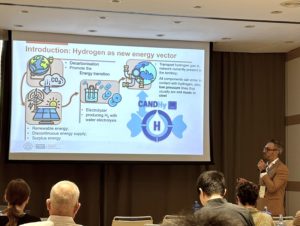
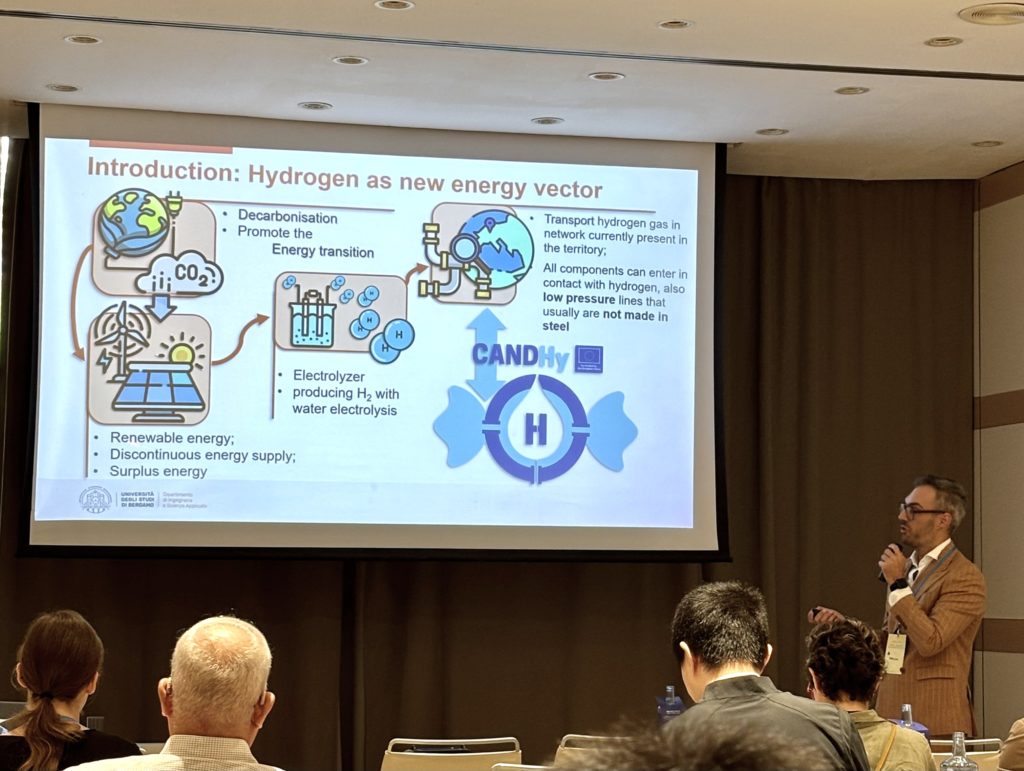
CANDHy presented the results of testing on the suitability of ductile cast iron in hydrogen environments at the Fracture Mechanics, Damage and Health Monitoring Conference (FDM 2026) last September 21 in Seville, Spain. Luca Gritti, Research Collaborator at the University of Bergamo, explained the main findings of the testing, focused on the formation and growth of defects due to hydrogen exposure in current gas grids. Thanks to this testing, CANDHy is providing experimental evidence to assess current and future hydrogen infrastructure.
CANDHy developed a Round Robin Test, involving three laboratories and various experimental techniques, investigating the material behaviour (spheroidal cast iron A and B) from complementary perspectives. The fracture mechanics tests included compact tension tests, slow strain rate tests, crack growth tests and fracture toughness measurements, under controlled hydrogen and nitrogen environments.
The first part of the testing programme focused on fracture initiation. J-integral tests were performed according to the ASTM E1820 standard, including tests under 16 bar H₂ and N₂. The results showed that hydrogen reduces the J₀.₂ value, indicating that less energy is required to initiate a defect.
The second part of the programme investigated the next steps after the fracture starts. Crack-growth behaviour was analysed using parameters including CTOD and CTOA, together with different deformation rates. The results showed that hydrogen has little to no significant effect on the crack growth rate under the conditions investigated.
In general, the results show that the influence of hydrogen on ductile cast iron is particularly relevant at the initiation of fracture. Hydrogen significantly reduces the energy required to initiate a defect, while its influence on subsequent crack growth is much less pronounced. Once a defect has been initiated, the inherently low ductility of ductile cast iron is the factor that allows it to propagate readily, with crack growth is provoked by the material’s intrinsic mechanical properties.
These findings provide valuable experimental evidence for the ongoing assessment of ductile cast iron as a potential material for low-pressure hydrogen transport applications.