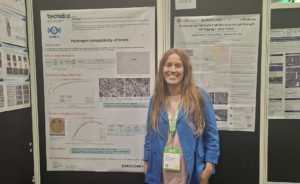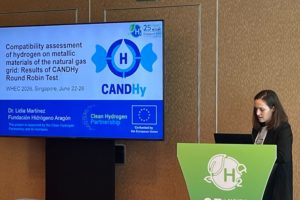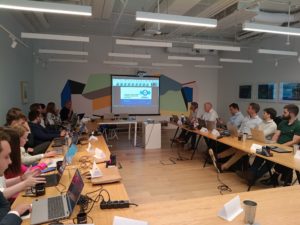
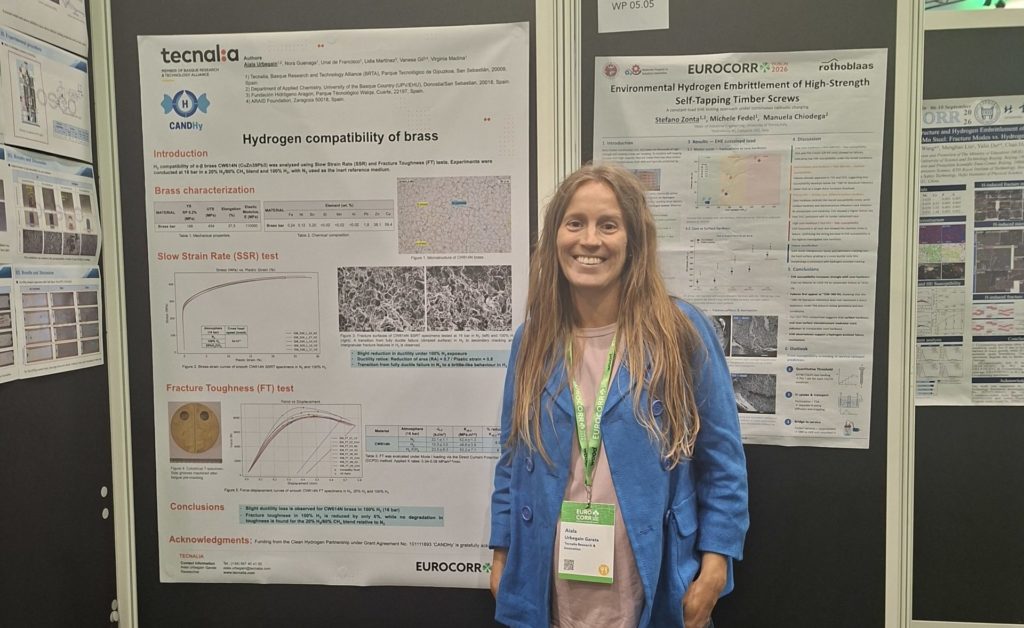
CANDHy reached the European Corrosion Congress 2026 (EUROCORR 2026) in Dublin, Ireland, this week to present the results of our tests on brass compatibility with hydrogen. Our partner TECNALIA presented the findings in a poster session, connecting with key stakeholders to share knowledge, discuss upcoming challenges, and explore the latest advances in the field.
Aiala Urbegain Garate, researcher at TECNALIA, shared this study that assesses whether this material can be safely used in hydrogen-related applications. The tests focused on the mechanical behaviour of brass when exposed to hydrogen and evaluated its susceptibility to hydrogen-assisted degradation.
The material was first characterised by its chemical composition and microstructure. Mechanical testing was then performed using Slow Strain Rate (SSR) and Fracture Toughness (FT) tests. These techniques allowed comparison of brass behaviour under different environments and determination of whether hydrogen exposure affects its strength, ductility, and resistance to fracture.
The SSR tests provided information on stress-strain behaviour and the possible influence of hydrogen on the material’s mechanical response. The fracture surfaces were also analysed by microscopy to identify changes in the fracture mechanism associated with hydrogen exposure.
The Fracture Toughness tests evaluated the resistance of brass to crack initiation and propagation. The results help determine whether hydrogen can reduce the material’s ability to withstand mechanical loading in the presence of defects or cracks.
Overall, the work improved the understanding of hydrogen–brass interactions and assessed the suitability of brass for components and systems that operate in hydrogen environments. The results have contributed to the development of safer and more reliable materials for the emerging hydrogen infrastructure.