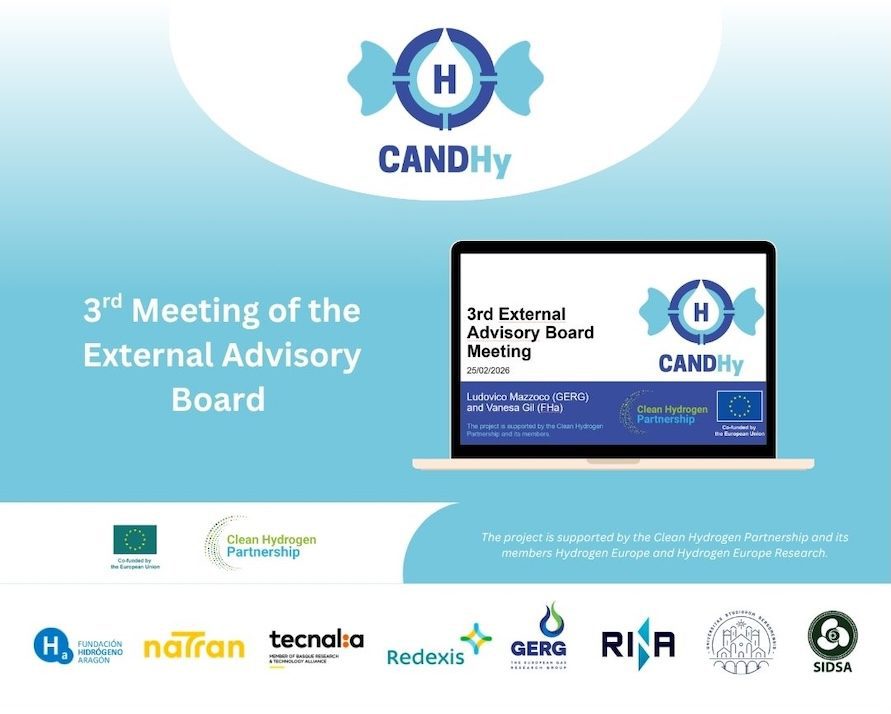
The CANDHy project held last February 25 its 3rd External Advisory Board (EAB) meeting. One more time, the project brought together key experts who are following our updates closely, and offered an overview of the tasks to be done in the next few months before the end of CANDHy.
The session opened with a welcome and introduction by Vanesa Gil, Head of Research & Development at Aragon Hydrogen Foundation (FHa) and Ludovico Mazzocco, Project Officer at the European Gas Research Group (GERG) and who outlined the current status of the project and the objectives of the meeting. Then, it was time for Lidia Martínez, Research & Development Coordinator at FHa, who provided an update on the status of the experimental campaign and the testing plan.
Virginia Madina, Senior Researcher at Tecnalia, presented the analysis of the Round Robin Test (RRT) results and introduced the project database. The presentation showcased the main outlines of the RRT, which included Slow Strain Rate Tests, fracture toughness measurements, C-ring stress tests, and CT-WOL/ KIH crack growth tests. The RRT were based on two types of materials: vintage ductile iron (Spool 1 and Spool 3) and new ductile iron (ID1 and ID2).
Marina Cabrini, Professor and member of the Department of Engineering and Applied Sciences at the University of Bergamo (UNIBG) and Luca Gritti, PhD student in Engineering and Applied Sciences followed with a presentation on a semi-empirical model of the influence of hydrogen in cast iron developed by the university. The model aims to correlate the microstructural parameters of certain materials with hydrogen absorption, diffusion, and embrittlement behaviour, based on experimental data provided by the project partners. To support this, they designed and conducted additional tests to evaluate hydrogen uptake, diffusion coefficients, internal concentration, and degassing behaviour using electrochemical charging and desorption analysis techniques.
The meeting concluded with a Q&A session, where attendees delved more into the details of each block and gave their feedback as members of the energy sector, providing valuable external insights and recommendations to refine the project’s direction.