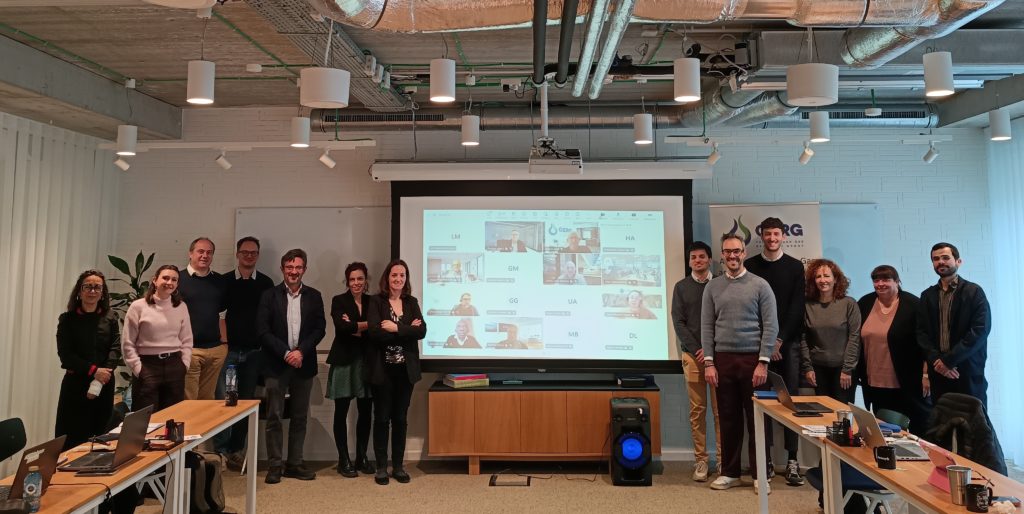
The CANDHy consortium celebrated its Final Meeting and Final Workshop on 3 and 4 November 2026, at the GERG – European Gas Research Group’s headquarters in Brussels, Belgium. The two-day programme combined an internal meeting among project partners with a public workshop for the hydrogen community, creating an opportunity to take stock of the project’s progress, present its scientific contributions and discuss the implications of its findings for the future use of hydrogen in existing gas infrastructure.
CANDHy Final Project Meeting
The first day, 3 November, was dedicated to the consortium’s Final Project Meeting. With the project’s scheduled completion approaching at the end of the month, partners reviewed the progress achieved across the different work packages and addressed the activities required to finalise the project. Lidia Martínez Izquierdo, R&D Coordinator at the Aragon Hydrogen Foundation and CANDHy Project Coordinator, and Vanesa Gil, R&D Head at the same organisation, reported on the status of project milestones, deliverables and the preparation of results for submission to the European Commission.
The technical discussions focused on the challenges encountered in understanding hydrogen-related material degradation. Virginia Madina, Researcher in Materials and Processes at TECNALIA, shared updates on the technical aspects of the project: models to explain hydrogen embrittlement, tests on hydrogen compatibility of new and vintage non-steel materials, a database on material compatibility with hydrogen and guidelines to evaluate the suitability of non-steel metallic materials exposed to hydrogen. From a dissemination and impact perspective, Ludovico Mazzocco, Project Officer at GERG – European Gas Research Group, outlined the actions undertaken to strengthen CANDHy’s visibility across the sector, highlighting engagement with relevant stakeholders and the next steps regarding the CANDHy results’ exploitation strategy.
CANDHy Final Workshop
On 4 November, attention shifted towards the wider hydrogen community with the CANDHy Final Workshop. The event welcomed 25 participants, attending either in person or online, and offered an opportunity to explore how the project’s research assesses the suitability of non-steel metallic materials for transporting hydrogen and hydrogen–natural gas mixtures through existing gas networks. The sessions were moderated by Ludovico Mazzocco and brought together contributions covering the project’s experimental work, modelling activities and practical outputs.
Opening the technical programme, Lidia Martínez Izquierdo introduced the project’s scope and provided an overview of the research activities carried out throughout its duration. Among the main achievements, she highlighted the mapping of non-steel metallic materials currently found in gas networks, the identification of remaining knowledge gaps concerning hydrogen compatibility, the experimental exposure of new and vintage materials to hydrogen, and the preparation of guidelines to support material compatibility assessments. Building on this overview, Virginia Madina shared the results of the CANDHy experimental testing campaign, presenting key observations on the new and vintage non-steel materials’ behaviour when exposed to hydrogen.
The programme then moved from experimental investigation to predictive tools and practical resources, deepening in the technical topics discussed during the first day. Marina Cabrini, Full Professor of Science and Technology of Materials at the University of Bergamo, discussed the modelling methodologies developed within the project, together with their results and the lessons learned in predicting hydrogen-induced embrittlement in metallic materials. Then, Jean-Baptiste Jorcin, Senior Researcher at TECNALIA, presented the CANDHy Database, a resource bringing together technical information on the compatibility of metallic materials with hydrogen. Completing the technical presentations, Roberta Delia, Fracture and Fatigue Mechanics Engineer at RINA, introduced the project’s material compatibility guidelines, designed to support the assessment of non-steel metallic materials exposed to pure hydrogen and hydrogen–natural gas mixtures. A final Q&A session allowed attendees to discuss the findings directly with the speakers and exchange perspectives on the challenges that remain.
Together, the two events provided a comprehensive picture of CANDHy’s contribution to the understanding of hydrogen compatibility in existing gas infrastructure. By combining experimental evidence, predictive modelling, a dedicated technical database and practical assessment guidelines, the project has developed resources that can help industry stakeholders address material-related challenges as hydrogen becomes an increasingly important part of Europe’s energy system.